
Have you ever agreed to something you did not want to do, simply because saying no felt selfish? Have you ever left a conversation feeling drained, flat or quietly resentful, and not been able to explain why?
In counselling rooms, this is one of the most common places people begin. Not with a crisis, but with a low, persistent tiredness. They describe a diary full of other people's priorities, a phone that feels like a demand, and a growing sense that they have gone missing somewhere inside their own life. When I ask what they need, there is often a long pause. Many people have simply never been asked.
Here is the part that tends to bring relief: poor boundaries are almost never a character flaw or a lack of willpower. Nobody is naturally bad at saying no. Boundaries sit on top of something much deeper — the beliefs we carry about our own worth, and the emotions we learned to override in order to keep the peace. Healthy boundaries grow out of healthy beliefs about ourselves. Change the belief, and the boundary becomes far less frightening.
What Are Healthy Boundaries?

A boundary is not a wall, and it is not a punishment. It is not a clever way of controlling someone else's behaviour either — that is where a lot of well-meaning advice goes wrong. You cannot make another person treat you well. What you can do is decide what you will accept, what you will not, and how you will respond when a line is crossed.
Think of it as the difference between a fence and a fortress. A fence marks where your garden ends and your neighbour's begins. It has a gate. People can be invited in. A fortress, on the other hand, keeps everyone out, including the people you love. Healthy boundaries are fences, and they are what make genuine closeness possible rather than dangerous.
Boundaries show up in more areas of life than most people realise.
Emotional boundaries
These protect your inner world — your feelings, your energy, and your sense of responsibility. An emotional boundary might sound like: “I can listen for a while, but I am not able to fix this for you.” It is also the quiet recognition that your partner's bad mood is not automatically your fault, and not automatically yours to solve.
Physical boundaries
Your body, your space, your comfort with touch. This includes telling an affectionate relative that you would rather shake hands, or asking a colleague to stop reading over your shoulder. Small, ordinary things — which is exactly why they are so often left unsaid.
Time boundaries
Time is finite, and every yes is a no to something else. A time boundary might be leaving a family lunch at three o'clock because you promised yourself a quiet afternoon, or declining the fourth committee this year without offering a three-paragraph justification.
Financial boundaries
Lending money, covering someone's shortfall again, splitting a bill fairly. Money carries a great deal of family history, which is why “I am not able to help with that this month” can feel harder to say than almost anything else.
Mental boundaries
Your right to your own thoughts, values and opinions — including the right to disagree without needing to win. “I understand why you see it that way. I see it differently” is a complete position. It does not require a debate.
Digital boundaries
Perhaps the newest and most frequently trampled. Who has access to you, and when. Whether messages get answered at eleven at night. Whether a group chat gets to shape your mood on a Sunday. Turning a phone face down is a boundary, even though nobody else sees it.

Why So Many People Struggle with Boundaries
Very few people arrive in adulthood without boundaries. What happens is subtler and sadder: they learn to override the ones they have. A child who notices that their sadness makes a parent uncomfortable learns to smile. A child in a home where anger was frightening learns that keeping everyone calm is their job. These are intelligent adaptations. They worked at the time. The difficulty is that they keep running long after the situation has changed.
Attachment plays a large part in this. When early relationships are inconsistent — warm one day, withdrawn the next — a child learns to monitor other people closely and to adjust themselves accordingly. That hypervigilance can become a lifelong habit of scanning faces for approval before checking in with yourself.
Family systems matter too. In some homes there is an unspoken rule that family members do not have separate needs, or that loyalty means never saying no. Where there has been trauma, the nervous system may have learned that appeasing is the safest strategy available; that response does not simply switch off because circumstances improve. If you are recovering from a relationship with someone who used guilt and pressure as tools, you may recognise this immediately — our article on the different types of narcissism and how to protect yourself looks at those dynamics in more depth.
Then there are the more everyday contributors: people pleasing that was praised as thoughtfulness, conflict avoidance learned from watching arguments end badly, low self-esteem that makes your preferences seem negotiable, and codependency, where being needed becomes the main way you know you matter.
Culture adds another layer, and in South Africa this is particularly worth naming. Many of us were raised with strong values around respect for elders, community, hospitality and self-sacrifice. Those values are genuinely good. But when they are applied without limits, they can quietly teach women in particular that their own needs come last, and that a good daughter, wife or colleague is one who never causes inconvenience.
None of this means you are broken. It means you learned something, in a context where learning it made sense. What is learned can be revisited.
The Underlying Beliefs That Make Boundaries So Difficult

Here is where a lot of boundary advice falls short. “Just be more assertive” assumes the problem is a missing skill. Most of the people I sit with are perfectly articulate. They can negotiate at work, advocate for their children, and argue a point beautifully on someone else's behalf. The moment it is for themselves, something stops them.
That something is usually a belief — an old rule about who you have to be in order to be loved. Poor boundaries are the symptom. The belief is the root.
See whether any of these sound familiar:
- “If I say no, people won't like me.”
- “My worth depends on helping others.”
- “I am responsible for other people's feelings.”
- “Conflict means rejection.”
- “Good people always put others first.”
- “I don't deserve to have needs.”
- “My needs are less important than everyone else's.”
- “I have to earn love.”
- “I shouldn't disappoint people.”
- “It's my job to keep everyone happy.”
Read them slowly. Most people find that one or two land with an uncomfortable thud. That thud is useful information.
These beliefs do not stay in your head. They come out as behaviour: people pleasing, over-explaining a simple no, apologising for things that are not your fault, rescuing people who have not asked to be rescued, avoiding necessary conversations, dropping your own plans without a second thought, and tolerating disrespect for far longer than you would ever advise a friend to.
Sarah — a composite of many people I have worked with — is a good example. She is forty-three, capable, well liked, and exhausted. She runs a department, chairs the school fundraiser, and takes her mother to every appointment. When her sister asked her to host Christmas for the eleventh year running, Sarah said yes before the sentence had finished, and then cried in the car. She did not need assertiveness training. She needed to look at the belief that had been running her life since she was nine: that being the reliable one was the only reason anyone kept her close.
The work is not to bully yourself out of these beliefs. It is to notice them, question them gently, and check whether they are still true.
Questions worth sitting with
- What am I afraid will happen if I say no?
- What belief is driving this decision?
- Is that belief actually true today?
- Where did I learn it, and who taught me?
- What healthier belief could replace it?
A replacement belief does not have to be grand. “I am allowed to have needs, even inconvenient ones” is plenty to begin with.
The Emotions Behind Poor Boundaries
Beliefs explain why boundaries are difficult. Emotions tell you, in real time, when one has been crossed. That flicker of irritation when a colleague drops work on your desk at five o'clock, the heaviness after a phone call with a certain relative, the tightness in your chest when you hear a particular tone of voice — these are not overreactions. They are data.
The trouble is that many people have become disconnected from their emotional world. If your feelings were dismissed, mocked or treated as a nuisance when you were young, you learned to stop consulting them. Ask how someone feels and the honest answer is often “I don't know”, or the two words that hide almost everything: “I'm fine.”
This is where the Emotions Wheel earns its place in counselling. It is a simple tool that helps people move from broad, blunt words like “bad” or “angry” towards more precise ones — dismissed, excluded, humiliated, powerless. Precision matters, because a vague feeling is hard to act on, while a named one usually points straight at the need or the boundary involved. Building this kind of emotional awareness is one of the most practical steps towards emotional intelligence and healthier relationships.
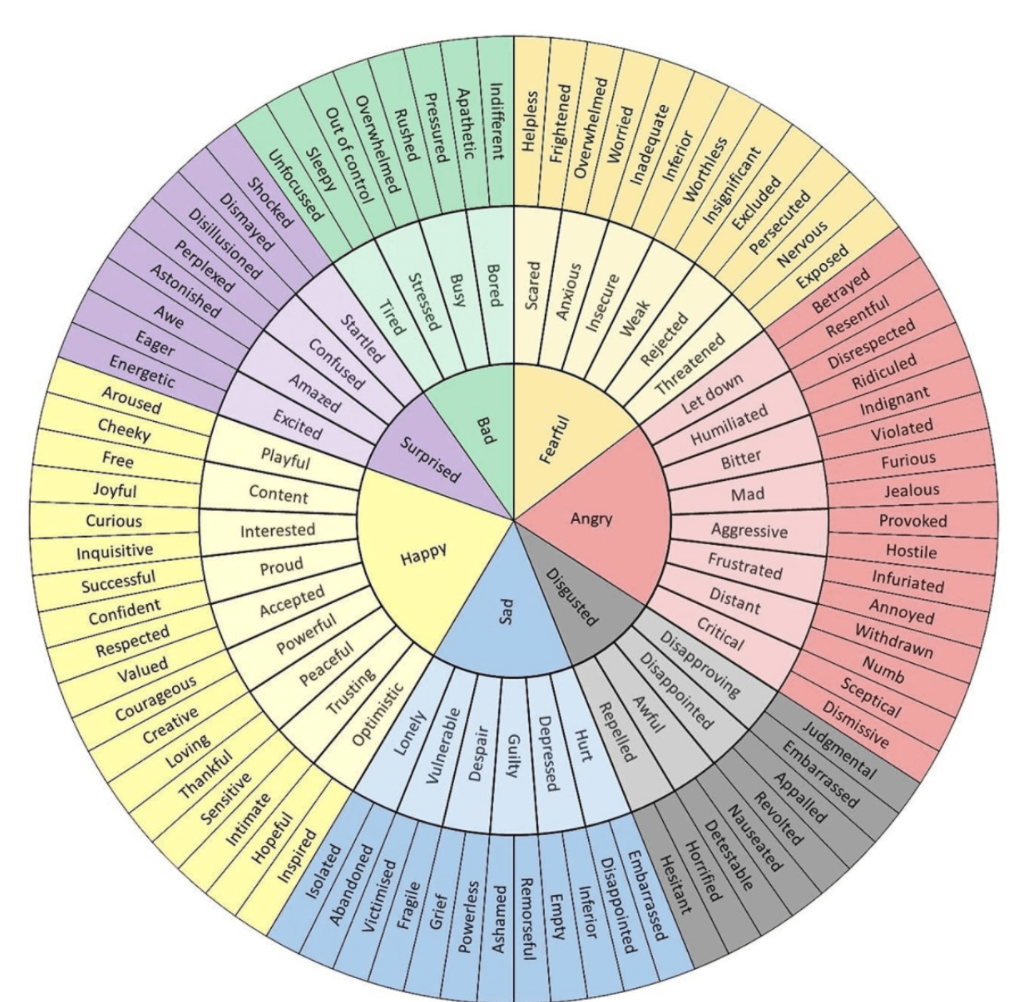
Working outwards from the centre of the wheel, here is how each family of emotions tends to shape our boundaries.
Fear
Fear is the most common reason a boundary never gets spoken. Underneath “I couldn't possibly say that” there is usually a specific fear: of rejection, of abandonment, of criticism, of conflict, of loneliness, or of disappointing someone whose approval has always mattered. Notice that none of these are fears about the task itself. They are fears about the relationship. That is why a small request can feel so disproportionately heavy.
Shame
Shame speaks in the language of character. Where guilt says “I did something wrong”, shame says “there is something wrong with me”. It shows up as feeling selfish for resting, guilty for saying no, unworthy of consideration, or convinced that your needs are an imposition. Shame is the reason so many people over-explain — the explanation is an attempt to prove they are still good.
Sadness
Sadness often arrives after years of unspoken boundaries. It can feel like being unseen in your own family, powerless in your own home, lonely inside a relationship, or emotionally neglected by people who would be genuinely surprised to hear it. Sadness is worth listening to rather than rushing past. It usually marks something that mattered.
Anger
Anger has a poor reputation, particularly among people raised to be agreeable. But anger is often the healthiest signal on the wheel. It tends to appear when a value has been violated, a boundary has been crossed, you have been treated unfairly, or you have once again overridden your own needs. Resentment is simply anger that has been swallowed and left to ferment.
Rather than suppressing it, get curious. What exactly am I angry about? What line was crossed? What would I need in order to feel respected here? Anger handled this way becomes clarity rather than an explosion.
Disgust
Disgust is less discussed, but people recognise it immediately when it is named. It is that recoil you feel after tolerating something that violated your dignity, or the self-directed version that follows repeated self-betrayal — the “I can't believe I let that happen again” feeling. Disgust is often the emotion that finally moves people to change something.
Surprise
Many people are genuinely surprised, once they start paying attention, at how disconnected they had become from their own emotional life. Discovering that you have been irritated for two years, or lonely inside a busy household, can be disorienting. It is also the beginning of something better.

A short emotional check-in
- What am I actually feeling, in one specific word?
- What happened just before I felt this?
- What need might this emotion be pointing towards?
- Has one of my boundaries been crossed?
- Am I responding to today's situation, or to an old wound?
Emotions are not problems to be eliminated. They are information. They point us towards our unmet needs, our values, and the boundaries we have not yet put into words.
Signs Your Boundaries Need Strengthening
Boundary difficulties rarely announce themselves. They show up as tiredness, irritability, or a vague sense that life is happening to you. A few common signs:
- Feeling guilty for days after saying no.
- Apologising constantly, including for things you did not do.
- Feeling responsible for managing everyone else's emotions.
- Burnout that a holiday does not seem to touch.
- Resentment towards people you genuinely love.
- Overcommitting, then dreading your own diary.
- Avoiding conflict so thoroughly that nothing gets resolved.
- Feeling emotionally drained after ordinary social contact.
- Being unable to ask for help, even when you are struggling.
- Not knowing what you want when someone asks.
If several of these describe your week rather than your worst month, it is worth paying attention.
How Poor Boundaries Affect Mental Health
Living without boundaries is expensive. When you are permanently available, permanently accommodating and permanently responsible for other people's comfort, your nervous system never really stands down.
Over time this shows up as chronic stress and burnout — not the dramatic collapse people imagine, but a slow flattening where nothing feels enjoyable and everything feels like an obligation. Anxiety often follows, because part of your attention is always monitoring how everyone else is doing. Low mood and depression can settle in when your own life stops containing anything that is genuinely yours.
Those in caring roles — nurses, teachers, pastors, social workers, and the family member who has quietly become everyone's carer — are especially vulnerable to compassion fatigue, where empathy itself begins to run dry. Relationship dissatisfaction grows too, because it is difficult to feel close to people you are quietly resenting. Many people also describe a loss of identity: they can list everyone else's preferences in detail and go blank when asked about their own.
Our article on managing anxiety when your mind won't slow down covers the physical side of this in more detail, and mindful communication is a useful companion piece once you begin having these conversations out loud.
Healthy Boundaries vs Emotional Walls

People who have been hurt often swing between two extremes: letting everyone in, or letting nobody in. Both feel like protection. Only one of them works.
A healthy boundary is flexible and specific. It says: “I am not available on Sundays, but I would love to see you during the week.” It keeps the relationship while protecting the need. A wall is rigid and total: “I don't do family anymore.” Walls are understandable, especially after emotional harm, but they tend to keep out warmth along with the danger.
Avoidance is a third pattern, and the most common one. It looks like agreeing to the plan and then cancelling at the last moment, or leaving a message unanswered for a week because a direct no feels impossible. People pleasing is the fourth: no visible boundary at all, and a growing private ledger of everything you have given.
A simple test: healthy boundaries usually leave you feeling steadier and still connected. Walls leave you safe but lonely. If your boundaries are producing isolation rather than relief, that is worth exploring, ideally with support.
How to Start Setting Healthy Boundaries
You do not need a personality transplant. You need practice, starting somewhere small enough that failure would not be catastrophic.
1. Recognise your needs
Before you can express a limit, you have to know one exists. For a fortnight, simply notice the moments when your body tightens, your mood drops, or you feel that flicker of reluctance. Write them down without judging them. You are gathering evidence, not building a case.
2. Know your values
Boundaries are far easier to hold when they are anchored to something you care about. “I don't work after seven” is fragile. “Evenings are for my family, and that matters more to me than being seen as endlessly available” is sturdy.
3. Communicate clearly
Be specific and brief. Vague boundaries invite negotiation. “I can help on Saturday morning, but I need to leave by twelve” is clear. “I'll see if I can maybe pop in” is an invitation to be overrun.
4. Use assertive communication
Assertiveness sits between passivity and aggression. It sounds like: “When meetings run past six, I miss bedtime with my son, so I'll need to leave at five thirty.” No blame, no apology, no lengthy defence. State the need, name the consequence, stop talking. Resist the urge to fill the silence — that is usually where the boundary gets bargained away.
5. Accept the discomfort
This is the part nobody enjoys. Your first few boundaries will feel awful, and the guilt will arrive right on schedule. Guilt is not evidence of wrongdoing; it is evidence that you have broken an old rule. It fades. Expecting it means it will not knock you off course.
6. Be consistent
A boundary held four times out of five teaches people to keep pushing for the fifth. Consistency, not intensity, is what makes a limit real.
7. Stop chasing everyone's approval
Some people will not like your boundaries, and that is survivable. The aim is not to be universally approved of. It is to be honestly known by the people who matter.
What Healthy Boundaries Sound Like
Most people find it easier to start with borrowed words. These are complete sentences — no justification required.
- “I won't be able to do that.”
- “I need some time to think about it. I'll come back to you tomorrow.”
- “I'm not comfortable with that.”
- “That doesn't work for me.”
- “I understand your perspective, but I see it differently.”
- “No, thank you.”
- “I can do the first part, but not the rest.”
- “I'd rather not discuss that.”
Notice how short they are. The instinct to add “because…” is strong, and it is usually the belief talking. A reason turns your boundary into a proposal that someone else can approve or reject.
When People Don't Respect Your Boundaries
Setting a boundary is also a quiet test of the relationship, and the response tells you a great deal.
Emotionally healthy people may be surprised or disappointed, and then they adjust. They might ask a question, express mild frustration, and get on with it. The relationship absorbs it.
People with unhealthy relational patterns tend to respond differently. They may become disproportionately angry, use guilt (“after everything I've done for you”), reframe the situation until you are apologising, withdraw affection as a punishment, criticise your character rather than address the request, or simply carry on as if you had said nothing.
This is where consistency matters most. When a boundary wobbles under pressure, it teaches the other person that pressure works. When it holds calmly and repeatedly — without argument, without a fresh explanation each time — most people eventually adjust. Those who do not are giving you important information about the relationship, and if that pattern feels familiar, the article on recognising narcissistic behaviour and protecting yourself is worth reading alongside this one.
Boundaries in Romantic Relationships
Long-term relationships tend to run into boundary trouble not through cruelty, but through drift. Two people slowly stop saying what they need, and resentment fills the gap.
Healthy boundaries in a partnership are about communication rather than distance. They sound like naming a need before it becomes a grievance: “I need twenty minutes when I get home before we talk about the day.” They protect independence — separate friendships, separate interests, time that is not shared — which is what keeps two people interesting to each other.
They also shape conflict. A boundary might be that raised voices end the conversation until both people are calmer, or that certain topics are not raised in front of the children. Emotional safety is built out of exactly these agreements: the confidence that a disagreement will not turn into contempt.
Where trust has been damaged, particularly in the aftermath of emotional manipulation or narcissistic abuse, boundaries become part of the healing itself. Rebuilding trust in your own perceptions — and learning that you are allowed to act on them — is often the central work of recovery. Couples counselling can help both partners practise this in the room rather than only in theory; you can get in touch about relationship counselling in Cape Town if that feels like a next step.
Boundaries with Family

Family is where boundaries are hardest, because the roles were handed out long before you had any say. The peacemaker, the responsible one, the strong one, the one who never complains. Changing a role that everyone else relies on tends to produce resistance, and that resistance is usually about the system rather than about you.
With parents, the difficulty is often the sense that you owe unlimited access. Loving your mother and declining a daily phone call are not in conflict, though it may take a while to believe that. With adult children, the challenge is the opposite: stepping back from rescuing, and letting them carry consequences you would rather absorb.
Siblings often replay childhood dynamics well into their fifties. Extended family bring opinions about your parenting, your marriage and your choices, usually at volume. Caregiving for an ageing parent deserves particular care, because the load so often falls to one person — usually a daughter — while everyone else expresses gratitude from a comfortable distance.
And then the holidays, where everything concentrates. It is entirely reasonable to arrive later, leave earlier, stay in a guesthouse, or host every second year. Decide in advance, tell people early, and keep the explanation short.
Boundaries at Work
Work boundaries feel risky because livelihoods are involved, so they need to be professional rather than confrontational.
After-hours contact is the obvious starting point. Being reachable at ten at night is a choice that quickly becomes an expectation. A simple “I pick messages up from seven in the morning” resets it without drama.
Work-life balance is less about perfect division than about protecting a few non-negotiables: the school run, one evening that is genuinely yours, leave that is actually taken rather than accumulated as proof of dedication. Burnout does not usually come from hard work; it comes from hard work with no end point and no recovery.
Saying no professionally is a skill worth practising: “I can take that on if we move the deadline on the other project — which would you prefer?” This is not obstruction. It is managing expectations honestly, and most reasonable managers respect it more than silent overwhelm followed by missed deadlines.
How Counselling Can Help

Some of this you can do on your own, with honesty and a notebook. But if boundary difficulties are rooted in childhood, trauma, or a relationship that taught you your needs were dangerous, self-help will often take you only so far. There is a limit to how far you can think your way out of something you learned in relationship — it usually has to be relearned in relationship too.
Counselling tends to help in a few specific ways.
- Emotional awareness. Learning to name what you feel, often with tools like the Emotions Wheel, so that you notice a crossed boundary at the time rather than three weeks later.
- Identifying limiting beliefs. Bringing the old rules into the open, where they can be examined instead of obeyed.
- Healing childhood wounds. Trauma counselling addresses the experiences that made appeasing feel like survival, so the nervous system can settle.
- Strengthening self-worth. Building a sense of value that does not depend on how useful you were this week.
- Developing assertiveness. Practising the actual sentences, out loud, with someone who will not punish you for them.
- Building healthier relationships. Learning to recognise reciprocity, and to tolerate the closeness that comes with it.
At Restoring Wholeness we offer individual counselling, relationship and couples counselling, and trauma counselling, both in Cape Town and online across South Africa. Whether the starting point is burnout, people pleasing, or recovery from an emotionally unhealthy relationship, the work usually begins in the same place: understanding what you feel, and why saying no has been so hard.
You Are Not Difficult for Having Limits
If you would like support in strengthening your boundaries, healing from an unhealthy relationship, or reconnecting with what you actually need, we would be glad to hear from you.
Frequently Asked Questions
A Gentler Way to Think About It

Healthy boundaries are not about becoming harder, colder or less generous. Most of the people who worry about becoming selfish are in no danger whatsoever of it. Boundaries are about becoming healthier — steadier in yourself, clearer with others, and far less exhausted.
When you understand the beliefs you inherited, listen to the emotions that have been signalling all along, and take your own needs seriously, boundaries stop feeling like rejection. They become less about saying no and more about saying yes to a life that reflects your values, your dignity and your wellbeing.
You are not broken. Your boundaries make sense once we understand what sits underneath them. And they can change, often more quickly than you expect, once someone helps you look.
If any of this has felt familiar, you are welcome to contact Restoring Wholeness — for individual counselling, relationship counselling or trauma counselling, in Cape Town or online.
About the Author
Pierre West is a Specialist Wellness Counsellor and the founder of Restoring Wholeness. He works with individuals, couples and families across Cape Town and online, supporting people through burnout, people pleasing, relationship difficulties and recovery from emotionally unhealthy relationships.
Book a session with Pierre